Meet Inspiring Speakers and Experts at our 3000+ Global Events with over 1000+ Conferences, 1000+ Symposiums and 1000+ Workshops on Medical, Pharma, Engineering, Science, Technology and Business.
Explore and learn more about Conference Series : World’s leading Event Organizer
On behalf of the organizing committee, it is with great pleasure that we welcome you to the 11th Global Entrepreneurship & Business Management Summit here in Dubai, UAE. This event brings together entrepreneurs, industry leaders, innovators, and thought leaders from around the world to explore the future of business and entrepreneurship in an increasingly interconnected global landscape.
Our theme this year, "Scaling Vision: Entrepreneurial Growth in a Connected World," highlights the exciting opportunities and challenges of growing a business in an era defined by rapid technological advancements, digital connectivity, and global networks. As the world becomes more interconnected, entrepreneurs have more tools than ever to scale their businesses and expand their impact — but they also face new complexities that require creativity, resilience, and adaptability.
Over the next two days, you will have the chance to engage with world-class speakers, thought leaders, and fellow entrepreneurs who are leading the way in innovative business practices. You’ll learn about the latest trends, technologies, and strategies to scale your vision, navigate the global marketplace, and build sustainable, impactful businesses in a connected world.
This summit is not just an event; it’s a platform for collaboration, inspiration, and growth. We hope you leave with fresh perspectives, new partnerships, and a renewed sense of purpose to take your entrepreneurial journey to the next level.
Thank you for being part of this exciting event. We look forward to a productive, inspiring, and transformative summit!
Warm regards, Conference Series LLC Ltd Organizing Committee
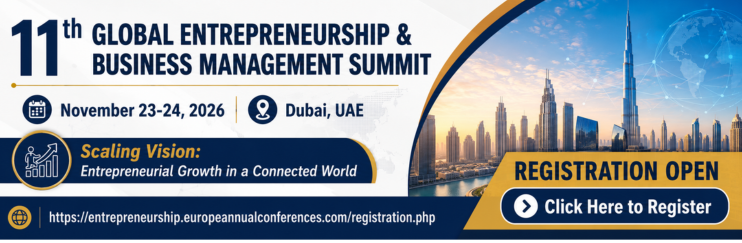
11th Global Entrepreneurship & Business Management Summit
November 23-24, 2026 | Dubai, UAE
About the Conference
The 11th Global Entrepreneurship & Business Management Summit, scheduled for November 23-24, 2026 in Dubai, UAE, is a premier international platform organized by Conference Series LLC Ltd that brings together entrepreneurs, business leaders, innovators, academicians, investors, and policymakers from around the world.
Centered around the theme “Scaling Vision: Entrepreneurial Growth in a Connected World,” the summit focuses on the strategies, innovations, and leadership practices required to grow businesses in today’s digitally connected and globally competitive environment. As markets become increasingly interconnected, the conference aims to explore how entrepreneurs and organizations can leverage technology, collaboration, and sustainable practices to scale their impact across borders.
The two-day summit will feature keynote presentations, panel discussions, workshops, and networking sessions led by renowned experts and industry pioneers. Participants will gain valuable insights into emerging business models, startup ecosystems, digital transformation, financial management, global market expansion, and innovation-driven entrepreneurship.
The 11th Global Entrepreneurship & Business Management Summit serves as a dynamic knowledge-sharing and networking hub, fostering meaningful collaborations and empowering attendees to transform ideas into scalable, successful ventures. Set in the vibrant business hub of Dubai, the conference offers a unique opportunity to connect with global leaders and be part of conversations shaping the future of entrepreneurship and business management.
Why Attend Global Entrepreneurship Summit 2026 ?
Attending a reputable international conference at the right time can lead to significant professional and academic benefits. The 11th Global Entrepreneurship & Business Management Summit offers a unique platform to connect, learn, and grow in today’s rapidly evolving global business environment.
Key Reasons to Attend
Engage with prominent entrepreneurs, business leaders, and innovators from around the world
Discuss the latest trends, challenges, and innovations in entrepreneurship and business management
Gain valuable insights into the opportunities and risks of starting and scaling a business
Meet and interact with influential figures from diverse industries and academic institutions
Facilitate the exchange of knowledge, ideas, and best practices across sectors
Conduct one-to-one discussions and interviews with fellow business professionals globally
Encourage collaboration between industry professionals, startups, investors, and academic researchers
Explore real-world case studies and practical strategies for business growth in a connected world
Benefits of Attending
Best Poster Award recognizing outstanding research and innovation
Outstanding Young Research Award to encourage emerging professionals and scholars
Group registration advantages for organizations, institutions, and universities
Keynote sessions by globally renowned researchers and industry experts
Strong representation from leading industries and global organizations
Opportunities to earn CME / CPD / POINTS credits (subject to eligibility and guidelines)
Access to conference handbooks, abstract books, and official conference kits
Digital Object Identifier (DOI) assignment for accepted abstracts and papers
Publication opportunities in indexed international journals and conference proceedings
Target Audience
The conference attracts a diverse audience, including:
Directors and CEOs
Business development directors
Entrepreneurs
Business professors
Elders
Ph.D. scholars
Start-up entrepreneurs
Business professionals
Presidents and Vice Presidents
Representatives from manufacturing enterprises
Experts and delegates
Importance & Scope:
The conference’s primary objective is to bring together various branches of business and entrepreneurship, providing a platform for exchanging experiences, insights, and challenges. Discussions will focus on cutting-edge topics and contemporary trends in business, offering participants valuable perspectives on growth, innovation, and emerging opportunities in the global market.
Innovation and Startup Ecosystems focuses on transforming new ideas into scalable businesses, emphasizing the latest trends and methodologies that drive entrepreneurial success. Real-world case studies from successful startups across various industries illustrate both the opportunities and challenges in scaling innovative ventures. Key elements of a thriving startup ecosystem, such as funding mechanisms, accelerators, mentorship, and supportive government policies, are discussed in depth. Collaborative innovation, where entrepreneurs, corporates, and academic institutions work together to address global challenges, is also highlighted. Strategies for building agile and sustainable business models that adapt to market changes are explored, along with the role of technology in enhancing operations, customer engagement, and scalability. Navigating global markets, identifying emerging opportunities, and establishing a competitive advantage are critical aspects covered, providing practical insights into growing and succeeding in today’s interconnected world. A comprehensive overview of building a robust startup ecosystem, scaling businesses effectively, and fostering long-term growth through innovation and strategic partnerships is provided.
Scaling Vision – Entrepreneurial Growth in a Connected World examines the strategies and frameworks that enable businesses to expand effectively in today’s highly interconnected global economy. The focus is on understanding how digital networks, global partnerships, and technological innovations can accelerate growth while maintaining operational efficiency and market relevance. Real-world examples from rapidly growing startups and multinational companies illustrate the challenges and opportunities involved in scaling across borders, industries, and markets. Key areas include building scalable business models, leveraging technology for communication, operations, and supply chain optimization, and adopting sustainable practices to ensure long-term growth. The impact of digital ecosystems, social media platforms, and cloud-based tools in connecting businesses to new markets and audiences is explored in depth. Emphasis is placed on aligning vision, strategy, and execution to achieve measurable growth, as well as overcoming barriers such as cultural differences, regulatory constraints, and competitive pressures. Strategies for managing resources, human capital, and innovation pipelines are analyzed to demonstrate how connected enterprises can thrive in a rapidly evolving business environment. Insights into collaborative approaches between startups, investors, and corporate partners highlight how businesses can create mutually beneficial relationships that drive growth and innovation. The session provides a comprehensive understanding of scaling entrepreneurial ventures successfully in a connected world, with actionable perspectives on sustaining growth, enhancing competitive advantage, and navigating complex global markets while fostering innovation, adaptability, and resilience across business networks.
Sustainable Business explores strategies for integrating environmental, social, and economic sustainability into modern business operations. The focus is on creating long-term value while minimizing negative impacts on the environment and society. Case studies from companies that have successfully implemented sustainable practices demonstrate practical approaches to energy efficiency, waste reduction, supply chain responsibility, and corporate social initiatives. The session examines how businesses can balance profitability with sustainability goals and adapt to increasing regulatory requirements and consumer demand for ethical practices. Emphasis is placed on innovation in sustainable products, circular economy models, and green technologies that drive both growth and positive impact. Collaborative approaches among businesses, governments, and communities are highlighted to show how partnerships can enhance sustainability outcomes. Strategies for embedding sustainability into corporate culture, decision-making, and stakeholder engagement are also covered. Insights into measuring environmental and social performance, implementing sustainable reporting frameworks, and leveraging sustainability as a competitive advantage are provided. The discussion illustrates how sustainable business practices not only contribute to global well-being but also foster resilience, brand reputation, and long-term financial success. By examining these principles, the session presents a comprehensive view of integrating sustainability into core business strategies, operations, and innovation pipelines to ensure that growth and profitability align with ethical and responsible practices.
Digital Transformation explores how businesses leverage technology to innovate, streamline operations, and enhance customer experiences in an increasingly digital world. The focus is on integrating advanced tools such as AI, big data analytics, cloud computing, and automation to drive efficiency, decision-making, and competitiveness. Case studies highlight companies that have successfully embraced digital transformation to enter new markets, optimize processes, and create value across their ecosystems. Key considerations include redesigning business models, implementing agile processes, and fostering a culture that supports continuous innovation and adaptation. The impact of digital platforms in connecting businesses to global markets, improving customer engagement, and enabling real-time insights is emphasized. Challenges such as cybersecurity, data privacy, and workforce adaptation are also explored, along with strategies to overcome these hurdles. Collaboration between technology providers, startups, and established organizations demonstrates how integrated digital strategies can accelerate growth and innovation. The analysis further covers methods to measure digital performance, optimize resource allocation, and align digital initiatives with overall business goals. By examining these aspects, the discussion provides a comprehensive understanding of how digital transformation reshapes industries, drives operational excellence, and positions businesses for sustainable success in a connected world.
Leadership & Management examines modern approaches to guiding organizations, managing teams, and fostering innovation in a complex business environment. The focus is on developing strategies for effective decision-making, organizational agility, and employee engagement while maintaining alignment with long-term goals. Examples from global companies illustrate leadership styles, strategic planning methods, and management practices that enable resilience, innovation, and growth. Key areas include cultivating emotional intelligence, fostering a culture of collaboration, empowering teams, and navigating change successfully. The role of ethical leadership, corporate governance, and inclusive practices is highlighted to ensure sustainable organizational success. Challenges such as conflict resolution, workforce diversity, and remote management are addressed, along with practical solutions for enhancing productivity and morale. Insights into performance measurement, succession planning, and leadership development programs provide a roadmap for building capable and visionary leadership. Strategies for aligning operational processes with strategic objectives, optimizing resources, and driving innovation pipelines are also examined. Overall, the discussion offers a comprehensive understanding of leadership and management practices that enable organizations to thrive, adapt, and achieve sustainable growth in today’s competitive and rapidly evolving business landscape.
Investment & Funding explores strategies for securing financial resources, attracting investors, and managing capital to support business growth and innovation. The focus is on understanding different funding sources, including venture capital, private equity, angel investors, crowdfunding, and government grants, and how to align financial planning with business objectives. Case studies demonstrate successful fundraising approaches, investment negotiations, and capital allocation strategies that enable startups and established businesses to scale efficiently. Key considerations include financial risk management, valuation methods, and structuring deals to optimize returns while maintaining operational flexibility. The impact of global financial trends, economic conditions, and investor expectations is examined, highlighting how businesses can adapt funding strategies to changing environments. Collaborative approaches between investors, entrepreneurs, and corporate partners are explored to foster mutually beneficial relationships and long-term growth. Insights into strategic planning, budgeting, and capital deployment provide a framework for making informed financial decisions. The discussion also addresses challenges such as balancing equity and control, meeting regulatory requirements, and ensuring sustainable cash flow management. By analyzing these aspects, it provides a comprehensive view of how effective investment and funding strategies can drive innovation, scale businesses, and create competitive advantages in a rapidly evolving global marketplace.
Marketing & Branding explores strategies for building strong brand identities, connecting with target audiences, and driving sustainable growth in competitive markets. The focus is on digital marketing, social media engagement, content creation, and understanding consumer behavior to design effective campaigns. Case studies from leading companies demonstrate how innovative marketing strategies, storytelling, and brand positioning can differentiate businesses and foster customer loyalty. The integration of analytics, CRM systems, and data-driven insights is highlighted as a way to optimize campaigns, improve decision-making, and measure performance. Techniques for launching products, entering new markets, and managing brand reputation are discussed, alongside methods for aligning marketing initiatives with organizational goals. Emphasis is placed on adapting to rapidly changing global trends, including shifts in consumer expectations, technological advancements, and sustainability-driven marketing practices. Collaborative strategies between marketing teams, product development, and external partners are also examined to ensure consistent messaging, enhanced customer engagement, and measurable outcomes. Additionally, the role of innovation in digital marketing, including AI-driven personalization, automation tools, and emerging social platforms, is explored to provide a comprehensive approach to modern marketing and branding practices. The discussion offers practical guidance for developing integrated campaigns, creating value for stakeholders, and sustaining competitive advantage through strategic brand management. By analyzing real-world examples and contemporary approaches, Marketing & Branding presents a holistic perspective on how businesses can leverage creativity, data, and strategic thinking to enhance market presence and achieve long-term success in an increasingly connected global economy.
Entrepreneurship & Innovation examines the process of identifying opportunities, creating solutions, and launching ventures that can adapt and thrive in competitive markets. The focus is on ideation, business model development, design thinking, and innovation management to transform ideas into scalable, sustainable businesses. Real-world examples illustrate the challenges of turning innovative concepts into profitable ventures, including risk assessment, resource allocation, and market validation. Strategies for fostering creativity, cultivating an entrepreneurial mindset, and leveraging technology to enhance efficiency and scalability are highlighted. Collaboration with investors, mentors, and corporate partners is explored as a mechanism to accelerate growth and increase market impact. The session also emphasizes the role of agile practices, iterative development, and continuous learning in maintaining competitive advantage. Case studies showcase successful entrepreneurial initiatives across various industries, illustrating how innovation drives economic growth and social impact. Key considerations include managing uncertainty, balancing risk and reward, and adopting sustainable practices to ensure long-term viability. Emerging trends such as digital entrepreneurship, platform-based business models, and the integration of AI and automation in startups are examined. Insights into scaling strategies, market expansion, and strategic partnerships provide a roadmap for converting innovative ideas into actionable business plans. Overall, Entrepreneurship & Innovation offers a comprehensive understanding of the principles, strategies, and tools needed to develop high-impact ventures that contribute to economic development, technological advancement, and a globally connected business ecosystem.
Global Business Strategies explores approaches for expanding operations internationally while navigating cross-cultural, regulatory, and market-specific challenges. The focus is on market research, strategic planning, international partnerships, and global supply chain optimization to achieve sustainable growth. Case studies highlight companies that successfully scaled across borders, demonstrating methods for entering diverse markets, adapting products and services to local needs, and responding to competition. Emphasis is placed on leveraging global networks, strategic alliances, and technology to enhance operational efficiency and market presence. Risk management strategies, including political, economic, and currency risk mitigation, are examined to ensure stability in complex international markets. Approaches for aligning corporate strategy with global objectives, while balancing local responsiveness, are discussed. Insights into organizational structure, leadership practices, and resource allocation provide a framework for effective international expansion. The session also explores emerging trends in globalization, including digital trade, e-commerce platforms, and cross-border innovation ecosystems, highlighting how businesses can capitalize on new opportunities while maintaining resilience. Strategic considerations such as cultural intelligence, compliance with international regulations, and sustainable practices in global operations are emphasized to enhance brand reputation and long-term growth. Overall, Global Business Strategies provides a comprehensive understanding of how enterprises can successfully navigate international markets, build competitive advantage, and achieve operational and financial excellence in today’s interconnected global economy.
Technology & Innovation Management focuses on integrating emerging technologies into business processes to drive growth, efficiency, and competitiveness. The session examines how organizations implement tools such as artificial intelligence, Internet of Things, robotics, automation, and digital platforms to optimize operations, improve decision-making, and foster innovation. Case studies highlight companies that have successfully leveraged technology to create new products, improve service delivery, and enhance customer experiences. Strategies for aligning technological adoption with organizational goals, resource allocation, and long-term planning are discussed, emphasizing the importance of innovation pipelines, research and development, and continuous improvement. Challenges such as cybersecurity, digital skill gaps, and investment prioritization are analyzed alongside solutions for overcoming these hurdles. The session also explores collaborative innovation, where partnerships between technology providers, startups, and corporates accelerate development and market entry. Approaches to measuring the impact of technological innovation, managing change, and maintaining competitive advantage are highlighted. Emerging trends, including AI-driven decision-making, blockchain applications, and smart automation, are examined to demonstrate how businesses can remain agile and forward-looking. By integrating technology with strategic management, Technology & Innovation Management offers a roadmap for organizations seeking to enhance efficiency, scalability, and value creation, ensuring they remain competitive and innovative in rapidly evolving industries.
Financial Management examines strategies for effective planning, allocation, and control of financial resources to support growth, stability, and innovation. The session covers budgeting, investment planning, capital structure optimization, and risk management to ensure sustainable operations. Case studies from businesses demonstrate practical approaches to financial decision-making, cost control, and resource allocation in dynamic markets. Topics include financial forecasting, cash flow optimization, performance measurement, and financial reporting practices. Emphasis is placed on aligning financial strategies with organizational objectives, managing uncertainty, and maintaining liquidity for strategic initiatives. Approaches for securing funding, evaluating investment opportunities, and assessing returns on capital are discussed, alongside methods for balancing short-term needs with long-term growth. Risk mitigation strategies, including currency, credit, and market risk management, are highlighted to ensure resilience. The session also explores emerging trends such as fintech innovations, digital banking, and alternative financing solutions, demonstrating how technology influences financial management practices. Insights into strategic planning, scenario analysis, and aligning financial policies with business objectives provide a comprehensive view of resource optimization. By integrating financial planning with strategic management, Financial Management illustrates how organizations can achieve operational efficiency, sustain growth, and build competitive advantage in a rapidly changing economic landscape.
Corporate Governance examines frameworks, policies, and practices that ensure transparency, accountability, and ethical decision-making in organizations. Topics include board structures, regulatory compliance, corporate responsibility, and stakeholder engagement, highlighting how governance supports sustainable growth and organizational integrity. Case studies illustrate how companies balance governance requirements with innovation and strategic initiatives, maintaining accountability while driving performance. The session addresses risk management, compliance monitoring, and performance evaluation to safeguard reputation and build stakeholder trust. Ethical leadership, transparency in decision-making, and aligning governance practices with business objectives are emphasized. Additionally, the role of governance in fostering innovation, employee engagement, and organizational resilience is explored. Strategies for integrating environmental, social, and corporate responsibility into governance structures are discussed, demonstrating the intersection of ethics, strategy, and performance. Emerging trends such as ESG reporting, sustainable governance practices, and global regulatory frameworks are analyzed to provide insight into best practices. The session highlights how robust corporate governance enhances operational efficiency, mitigates risks, strengthens credibility, and ensures long-term value creation. By examining both traditional and innovative governance approaches, Corporate Governance provides a comprehensive understanding of maintaining ethical standards while supporting organizational growth and competitiveness in a complex global business environment.
Business Analytics focuses on using data-driven insights to improve decision-making, operational efficiency, and strategic planning. Topics include data collection, analysis, visualization, predictive modeling, and performance measurement. Case studies illustrate how analytics has transformed operations, marketing, finance, and supply chain management across industries. Emphasis is placed on integrating analytics into organizational processes to gain competitive advantage, optimize resources, and identify emerging trends. Advanced techniques such as machine learning, AI-based predictive analytics, and big data applications are explored to demonstrate how businesses can anticipate market shifts and customer needs. The session covers frameworks for interpreting complex datasets, translating insights into actionable strategies, and measuring ROI from analytics initiatives. Challenges related to data quality, privacy, and ethical use are addressed, along with solutions for ensuring accuracy, compliance, and effectiveness. The discussion highlights the role of cross-functional collaboration between data scientists, business leaders, and technology teams to create a culture of data-driven decision-making. By leveraging analytics strategically, organizations can enhance operational performance, improve customer experiences, and drive innovation, ensuring sustainable growth and resilience in competitive markets.
Human Resource Management explores strategies for talent acquisition, development, retention, and organizational performance. Topics include employee engagement, learning and development, performance evaluation, leadership development, and workforce planning. Case studies highlight innovative practices that improve productivity, foster employee satisfaction, and build resilient organizational cultures. The session addresses managing diversity, inclusion, and change in dynamic business environments, alongside strategies for succession planning and career development. Approaches to aligning HR practices with strategic goals, optimizing workforce performance, and leveraging technology such as HR analytics and digital platforms are discussed. Employee motivation, retention, and workplace well-being are emphasized as critical factors in maintaining productivity and innovation. Best practices for recruitment, training programs, and performance management systems are explored to enhance long-term organizational effectiveness. Emerging trends such as remote work, flexible employment models, and skills transformation are analyzed to illustrate how HR practices adapt to modern business challenges. By integrating strategic HR management with business objectives, Human Resource Management provides a comprehensive perspective on developing talent, enhancing engagement, and sustaining organizational growth in competitive and evolving markets.
Supply Chain & Operations examines strategies for optimizing processes, logistics, and resource management to improve efficiency, reduce costs, and maintain competitiveness. Topics include procurement, inventory management, production planning, distribution, and technology integration in supply chains. Case studies showcase organizations that have successfully streamlined operations, implemented lean practices, and leveraged digital tools for operational efficiency. Emphasis is placed on risk management, sustainability, and adaptability to changing market conditions. The session explores integrating emerging technologies such as IoT, AI, and blockchain to enhance visibility, forecasting, and decision-making across the supply chain. Best practices for collaboration with suppliers, partners, and stakeholders are discussed to strengthen resilience, reduce delays, and improve customer satisfaction. Strategies for aligning operational processes with business objectives, managing resources effectively, and maintaining service quality are highlighted. Sustainability and ethical practices in sourcing, production, and logistics are addressed to support corporate responsibility and long-term growth. The discussion illustrates how effective supply chain and operations management creates competitive advantages, drives innovation, and ensures organizational resilience in dynamic global markets.
Risk Management explores identifying, assessing, and mitigating risks across business operations to ensure stability, resilience, and sustainable growth. Topics include financial, operational, strategic, reputational, and cybersecurity risks, along with frameworks and methodologies for managing uncertainty. Case studies illustrate companies that successfully implemented risk assessment tools, crisis response strategies, and contingency planning to protect assets and maintain market confidence. Emphasis is placed on integrating risk management into strategic decision-making, aligning risk policies with organizational goals, and fostering a proactive risk-aware culture. The session also examines emerging risks related to digital transformation, global supply chains, regulatory changes, and geopolitical instability, highlighting strategies to anticipate and respond effectively. Risk governance structures, monitoring, and reporting mechanisms are explored, demonstrating how organizations can balance risk exposure with growth opportunities. Techniques for scenario planning, stress testing, and business continuity planning are included to prepare enterprises for unforeseen challenges. The role of technology in enhancing risk management through predictive analytics, monitoring tools, and data visualization is emphasized. Collaboration between risk managers, leadership teams, and operational units ensures that mitigation strategies are practical, integrated, and adaptable. By analyzing best practices, frameworks, and real-world examples, Risk Management provides a comprehensive understanding of building resilience, safeguarding organizational performance, and maintaining competitive advantage in complex, volatile business environments.
Corporate Strategy examines the formulation and execution of long-term plans to achieve organizational objectives, competitive advantage, and sustainable growth. The focus is on aligning mission, vision, and strategic initiatives with market opportunities, operational capabilities, and industry trends. Case studies illustrate how companies develop strategic roadmaps, assess market positioning, and prioritize resource allocation. Topics include portfolio management, diversification, mergers and acquisitions, innovation strategy, and international expansion. Emphasis is placed on decision-making frameworks, performance measurement, and adaptability in dynamic markets. Techniques for analyzing competitive landscapes, forecasting industry trends, and integrating technology into strategic planning are explored. Collaborative approaches between leadership, operational teams, and stakeholders ensure effective execution and alignment with organizational goals. The session also addresses challenges such as market disruptions, resource constraints, and changing customer demands, along with strategies to maintain resilience and agility. Corporate Strategy highlights the importance of integrating financial, operational, and technological considerations into cohesive plans. By examining real-world examples, strategic tools, and emerging trends, it provides a comprehensive understanding of creating value, sustaining competitive advantage, and achieving long-term success in complex global business environments.
Innovation in Services focuses on designing and implementing creative solutions to enhance customer experience, operational efficiency, and service delivery. The discussion includes emerging service models, digital platforms, automation, and AI applications that improve quality and responsiveness. Case studies highlight businesses that have transformed their service offerings through technology, process innovation, and customer-centric strategies. Topics include service design thinking, process reengineering, and value co-creation with customers and stakeholders. Emphasis is placed on integrating innovation into core operations, leveraging data analytics, and adopting agile practices to respond quickly to market demands. Strategies for enhancing scalability, efficiency, and competitiveness while maintaining service quality are examined. The session also explores challenges in managing service innovation, including workforce adaptation, cultural change, and balancing cost with customer value. Insights into measuring service performance, innovation impact, and customer satisfaction provide a framework for continuous improvement. Collaborative approaches with technology providers, partners, and clients are highlighted to co-create innovative solutions that drive market differentiation and sustainable growth. By combining practical examples, emerging trends, and strategic approaches, Innovation in Services offers a comprehensive perspective on how businesses can transform operations, exceed customer expectations, and achieve competitive advantage in service-driven industries.
Strategic Marketing focuses on long-term planning, market positioning, and customer-centric approaches to achieve business objectives and growth. The discussion emphasizes segmentation, targeting, positioning, and differentiation strategies, as well as integrated marketing communications to strengthen brand value. Case studies demonstrate how companies leverage data analytics, digital marketing, social media, and content strategies to drive engagement and loyalty. Topics include customer experience management, brand equity, competitive analysis, and marketing ROI assessment. Emphasis is placed on aligning marketing initiatives with corporate strategy, identifying emerging trends, and adapting to changing consumer behaviors. Strategies for product launches, global market expansion, and sustainable marketing practices are explored. The session also highlights collaborative approaches between marketing, product development, and sales teams to ensure cohesive execution and measurable outcomes. Techniques for evaluating performance, optimizing budgets, and leveraging technological tools such as CRM and AI-powered analytics provide actionable insights. Strategic Marketing offers a comprehensive understanding of how businesses can create value, maintain market relevance, and achieve sustainable growth by integrating marketing intelligence, innovation, and customer-focused strategies in an increasingly competitive and connected marketplace.
Emerging Technologies explores innovations shaping the future of business, including AI, blockchain, IoT, robotics, augmented reality, and quantum computing. The discussion focuses on how these technologies transform operations, product development, and customer engagement while creating new business models. Case studies illustrate successful adoption, implementation challenges, and strategies for integrating technology into existing systems. Emphasis is placed on evaluating potential impact, scalability, and alignment with organizational goals. The session also examines regulatory considerations, cybersecurity, ethical implications, and workforce adaptation. Collaborative approaches between technology providers, startups, and enterprises highlight methods to accelerate innovation and competitive advantage. Techniques for monitoring technology trends, prioritizing investments, and developing innovation pipelines are explored to ensure sustainable growth. Insights into combining multiple technologies, driving operational efficiency, and enhancing customer experiences demonstrate how emerging tools create market differentiation. By analyzing real-world applications, adoption strategies, and future trends, Emerging Technologies provides a comprehensive understanding of leveraging technological advancements to innovate, remain competitive, and thrive in rapidly evolving global business environments.
Global Market Growth
The global business and entrepreneurship markets are projected to experience steady growth between 2026 and 2031, driven by digital transformation, technological adoption, and expanding global markets. The digital transformation market alone, currently valued at around USD 1.5 trillion, is expected to grow at a CAGR of ~27%, reflecting widespread adoption of AI, cloud computing, big data, and IoT solutions. Enterprise development and business management consulting markets are also expanding, with projected CAGRs of 5.6% and 6.2% respectively, fueled by demand for strategic guidance, innovation integration, and digital efficiency. Small and medium enterprises are anticipated to grow from approximately USD 72 billion in 2025 to USD 114.5 billion by 2032, demonstrating resilience through tech adoption and niche business models. Online business education and upskilling initiatives are also accelerating, with a projected 22.5% CAGR, as professionals prepare for AI-driven and digitally-enabled workplaces.
Key trends shaping market growth include AI and technology-driven innovation, digital transformation, and sustainability. Businesses are increasingly leveraging AI for decision-making, process automation, and customer engagement, while global digital platforms enable connectivity and operational efficiency. E-commerce is expected to expand significantly, reaching around USD 8.1 trillion by 2026, reflecting shifting consumer behavior toward online retail. Sustainability and ESG practices are becoming core to investment and operational strategy, as companies integrate ethical business practices, climate-friendly operations, and social responsibility to meet both regulatory standards and market expectations. Emerging markets such as Asia-Pacific, Africa, and Latin America are anticipated to contribute substantially to global growth, driven by rising urbanization, expanding digital infrastructure, and a growing middle class.
Workforce transformation, skills development, and entrepreneurial adaptability are additional drivers of market expansion. The demand for digital, AI, and data-centric skills is rising sharply, creating opportunities for innovative startups and established enterprises alike. Businesses that effectively align strategic planning, technological adoption, and sustainability initiatives are expected to gain competitive advantage, scale efficiently, and thrive in increasingly interconnected markets. Overall, the next five years point toward a technology-driven, globally connected, and innovation-led economy, offering significant growth potential across industries, regions, and market segments.
Speaker
Deliver keynote or invited lectures.
Share cutting-edge research, innovations, and insights with global delegates.
Delegate
Attend scientific sessions, panel discussions, and networking events.
Access conference materials and interact with experts across the field.
Poster Presenter
Showcase original research through printed or digital posters.
Engage in one-on-one discussions with attendees and experts.
Exhibitor
Display products, technologies, or services in dedicated exhibition spaces.
Network with delegates, potential clients, and collaborators.
Video Presentation
Present research findings or innovations via recorded video sessions.
Ideal for participants unable to attend in person.
E-Poster Presenter
Share research electronically through interactive e-posters.
Participate in virtual discussions with attendees.
Virtual Registration
Attend live-streamed keynote sessions, presentations, and panel discussions online.
Access conference recordings, digital materials, and participate in virtual networking.
Ideal for international participants or those unable to attend in person.
Earn CPD/CME points
Networking opportunities with global experts and peers
Certificate of participation
DOI publication opportunities in conference proceedings
Access to cutting-edge research
Professional visibility for speakers, presenters, and exhibitors
Opportunities for global collaboration
Abstract Submission Open: Now Open
Early Bird Registration: July 20, 2026
Standard Registration: September 14, 2026
Final Registration Deadline: November 23, 2026
Abstract Submission Details:
All abstracts submitted will undergo a peer-review process to ensure scientific quality and relevance.
Authors will receive an Abstract Acceptance Letter upon approval, confirming inclusion in the conference program.
Accepted abstracts will be published in the conference proceedings with DOI, providing global visibility and citation opportunities.
The 10th Global Entrepreneurship & Business Management Summit, taking place on November 24–25, 2025, in the scenic and culturally rich setting of Bali, Indonesia, promises to be a landmark event in the global business landscape. The summit is dedicated to uniting trailblazers, innovators, and industry leaders under the theme “Innovating for Tomorrow: Empowering Global Leaders in Business and Entrepreneurship.” As businesses continue to evolve in the face of digital disruption, sustainability imperatives, and shifting global markets, this event serves as a powerful platform to exchange knowledge, inspire new ventures, and promote impactful leadership. Attendees will experience a thoughtfully designed program that blends academic research, industry expertise, and policy-level insights to address the most pressing issues facing the modern entrepreneurial world.
A highlight of the summit will be its dynamic keynote addresses, delivered by prominent figures in global business, innovation, and leadership. These keynote sessions will explore future trends in technology, investment strategies, and sustainable business growth. In addition to the keynotes, the summit will host a series of oral presentations, where selected speakers will share breakthrough ideas, case studies, and research findings in the fields of entrepreneurship and business management. Interactive panel discussions, startup pitching arenas, and hands-on workshops will further enhance the learning and networking experience, allowing delegates to collaborate with peers and decision-makers from across industries and regions.
Beyond the professional benefits, the summit's location Bali, Indonesia adds a remarkable dimension to the experience. Known for its natural beauty, cultural depth, and spiritual richness, Bali offers a unique environment that blends reflection with inspiration. From sunrise business talks overlooking the ocean to evening networking receptions in tropical gardens, participants will find opportunities to recharge while deepening their global connections. Whether you are an established entrepreneur, a startup enthusiast, an academic, or a policymaker, the Global Entrepreneurship & Business Management Summit 2025 in Bali is your gateway to new ideas, meaningful collaborations, and long-term impact.